Museum of Mineralogy and Geology |

|
In one of the nicest buildings of the Delft University of Technology, the faculty of Applied Earth Sciences was housed. In one of the wings of this beautiful building the Museum of Mineralogy and Geology was situated.
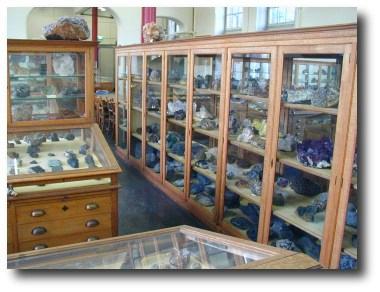
Some showcases in the museum
In showcases unique clear quartz crystals were exhibited, fist sized purple fluorite cubes, giant clear gypsum crystals, and many less well-known minerals with lustrous colours and shapes. Rocks were on display that tell tales of the history of Earth, as well as ores of silver, lead, zinc, copper, gold and many other metals, often from mines that are now long forgotten and deserted. The museum also had an enormous skull of a Triceratops dinosaur, a print of the Archaeopteryx, world's first bird, and the skeleton of a Dodo, the famous walker bird that was exterminated by men. The showcases' drawers were filled with scientific reference collections of minerals, rocks and ores from places all over the world.
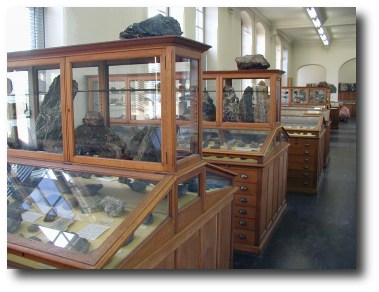
Showcases filled with scientific reference collections
Students and teachers of the faculty of Applied Earth Sciences use the collections for education in mineralogy.
Museum History
The Museum of Mineralogy and Geology is homed in the building of the faculty of Applied Earth Sciences of the Delft University of Technology. The history of the museum is directly related to the history of the study of Applied Earth Sciences. In 1912, Applied Earth Sciences was appointed an own building on Mijnbouwstraat in Delft. A part of this building was reserved for the museum.
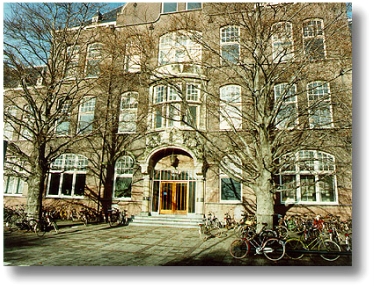
Front entrance of the building of Applied Earth Sciences
In 1842 the "Royal Academy for the Education of Civil Engineers" ("Koninklijke Academie ter opleiding van burgerlijke ingenieurs") was founded in Delft. This Academy held a number of courses amongst which the course of Mining Engineering. The Royal Academy was later transformed from "Polytechnische School" and "Technische Hoogeschool" to the present day University of Technology.
At the time of foundation of the Academy in 1842, professor Bleekrode, a medical man, was appointed to organise the course of Mining Engineering. He was succeeded in 1864 by professor Vogelsang. This was the first professor that was originating from the mining world. Under his lead a scholarly study of Mining was developed. Vogelsang's opinion was that a study of Mining Engineering could not do without a study collection of minerals, rocks, fossils, ores and other geological objects. He started a collection, which was the first step to the museum as we now know it. From that day onwards, students and employees collected many materials during excursions, practical works and field works. The collection was rapidly growing. In 1905, professor Molengraaff succeeded Vogelsang. In the many expeditions he led, a large amount of materials were collected. When in 1912 the study of Mining Engineering was appointed a new building at Mijnbouwstraat, the collection was already large enough to fill three floors of one wing of the new building as a museum.
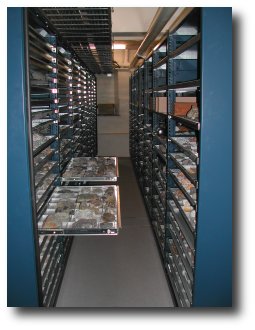
A storeroom of the museum
The collections present in the museum reflect the geological education given at the sub faculty of Applied Earth Sciences. Since 1842 the educational programme has been changed much. Also the importance of some of the study collections changed as a result. The collections that were assembled in the former Dutch colonies as well as the collection of fossils lost their importance for the study. These collections were transferred to the Dutch National Natural Historical Museum Naturalis in Leiden. The remaining collections, the collections Systematical Mineralogy, General Geology, Rocks and Ores are on display in the exhibition area, organised according to internationally used classification systems, and have amongst others the use of supporting the education given at the faculty of Applied Earth Sciences.
Note for our English speaking visitors:
apart from the page you are reading right now and the page with information for visitors, unfortunately all other pages on this website are available in Dutch language only.