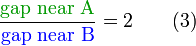
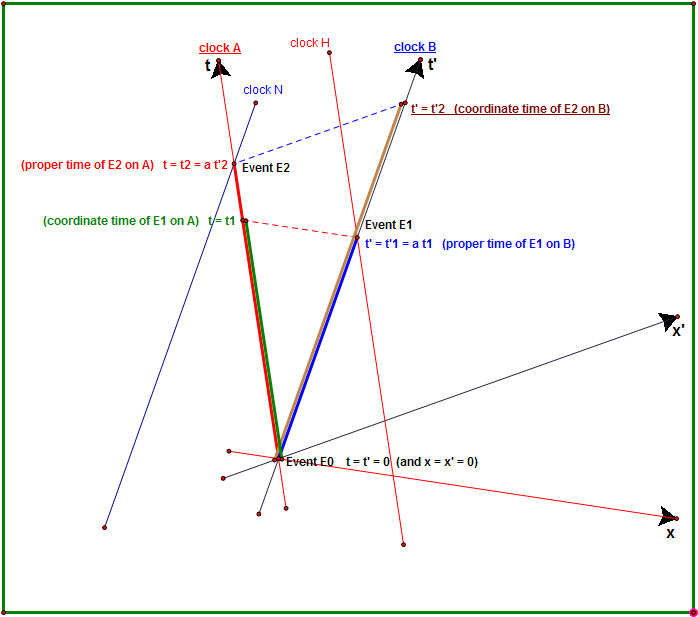
Thus, between events E0 and E1, A advances by t1 and B by t'1 = a t1 by
(1). Therefore
...
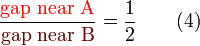
Thus, between events E0 and E2, B advances by t'2 and A by t2 = a t'2
by (2). Therefore
Equations (3) and (4) are contradictory: hence the theory requiring
them must be false.
(end quote)
Dingle should have written as follows:
(start correction)
Thus, between events E0 and E1, A, which is not present at both
events, advances by t1 and B, which is present at both events, by t'1 =
a t1 by (1). Therefore
...
Thus, between events E0 and E2, B, which is not present at both
events, advances by t'2 and A, which is present at both events, by t2 =
a t'2 by (2). Therefore
Equations (3) and (4) are consistent and say that any event's coordinate time
is always larger than its proper time: hence there is no reason to
say that the theory requiring them must be false.
(end correction)
Compare with the following simple analogy. This is how Dingle should have found a trivial contradiction in the laws of geometry and perspective.
X and Y are twin brothers
A and B are facing one another with some distance between them
P and Q are twin sisters
So X and P are standing nearby next to A, and Y and Q are standing nearby next to B.
A looks through a gap between her fingers at the twin brothers X and Y, and she notices that X's gap (nearby A) is twice as large as Y's (nearby B). Therefore for A it is true that
B looks through a gap between his fingers at the twin sisters P and Q, and he notices that P's gap (nearby A) is half as large as Q's (nearby B). Therefore for B it is true that
Clearly, equations (3) and (4) are contradictory: hence the theory of perspective behind them must be false.
Or is it?
Of course it isn't. The equations are just poorly expressed, and should be expressed as follows:
For A, looking at twin brothers X and Y, it is true that
For B, looking at twin sisters P and Q, it is true that
Clearly, equations (3) and (4) are consistent: hence there is no reason to think that the theory of perspective behind them must be false.
The trick to make this happen: proper understanding, proper labelling, proper expressing. Trivial.




 X and Y are twin brothers
 A and B are facing one another with some distance between them
 P and Q are twin sisters